

In harsh industrial environments—such as oil and gas refining, petrochemical processing, power generation, and offshore drilling—pipeline integrity is critical. Selecting the right 1-inch forged steel valve—or any other diameter—is vital to ensuring safe, zero-leakage fluid control under extreme temperatures and elevated pressure conditions. Whether you are specifying a 1-inch or larger diameter valve, the selection process demands careful evaluation of material, design, and application requirements.
Unlike cast valves, forged steel valves are manufactured through a solid-state forging process that refines the grain structure of the metal, offering superior tensile strength, impact resistance, and resistance to structural fatigue. These characteristics make them the preferred choice for critical services where failure is not an option.
When engineering a high-pressure piping system, three primary forged valve types dominate the market: gate valves, globe valves, and ball valves. Understanding their structural differences, flow dynamics, and operational mechanics is essential for proper valve selection. This guide focuses on 1-inch forged steel valves across all three types, providing engineers and procurement managers with the technical insights needed for confident decision-making.
1. Forged Steel Gate Valves: Ideal for On/Off Isolation
A 1-inch gate valve for isolation service is designed primarily for fully open or fully closed isolation applications. It operates by lifting a wedge-shaped gate out of the path of the flowing fluid.
Key Characteristics & Advantages
- Straight-Through Design: When fully open, the wedge completely retracts into the valve bonnet, creating a full-bore flow path with minimal pressure drop. For a 1-inch bore size, this translates to near-zero flow restriction.
- Bi-Directional Sealing: Forged gate valves provide tight shut-off regardless of the fluid flow direction.
- Heavy-Duty Construction: Standard designs conform to international standards such as API 602 and BS 5352, featuring bolted bonnets (BB) or welded bonnets (WB) for severe pressure ratings (Class 150 to Class 1500 and above). A 1-inch, Class 1500 forged gate valve, for example, is commonly specified for high-pressure steam applications.
Best Applications
Forged steel gate valves are widely used as main isolation valves in high-pressure steam lines, hydrocarbon processing, and feed water systems where fluid flow remains mostly uninterrupted. The 1-inch size is particularly common in auxiliary steam lines and small-bore process connections.
Engineering Note: Gate valves must never be used for throttling. Operating a gate valve in a partially open position causes severe vibration, disc erosion, and seat damage due to high-velocity fluid flow. For throttling applications, refer to the globe valve section below.
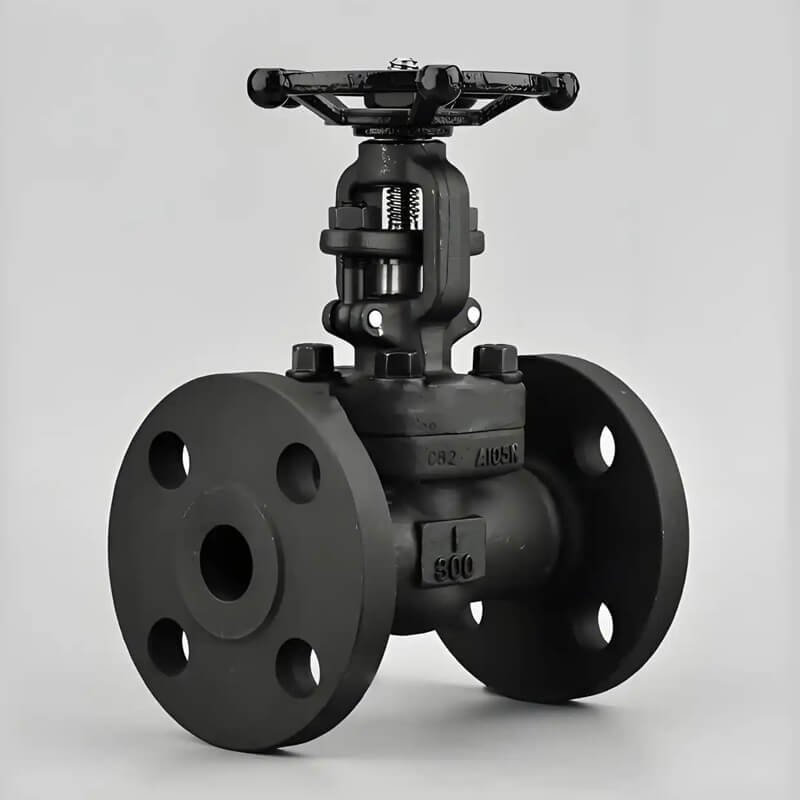
2. Forged Steel Globe Valves: Precise Flow Regulation and Throttling
When process control requires frequent operation or precise flow adjustment, a 1-inch globe valve for throttling is the preferred solution.
Key Characteristics & Advantages
- Z-Body Flow Path: The interior of a globe valve forces fluid to change direction, creating resistance that allows for accurate flow regulation and throttling. This is particularly effective in 1-inch and smaller line sizes where precise control is critical.
- Shorter Stem Travel: Compared to gate valves, the disk of a globe valve requires significantly fewer turns to open or close, reducing mechanical wear during frequent cycling.
- Superior Seat Maintenance: Because the disk moves perpendicular to the seat ring, seat wiping and wear are minimized, extending operational service life under high-pressure drop conditions.
Best Applications
Forged globe valves excel in boiler feed water regulation, chemical dosing lines, steam vents, and drain lines where tight flow control and reliable shut-off are paramount. A 1-inch forged globe valve is frequently specified for chemical injection systems and sampling lines in refineries.
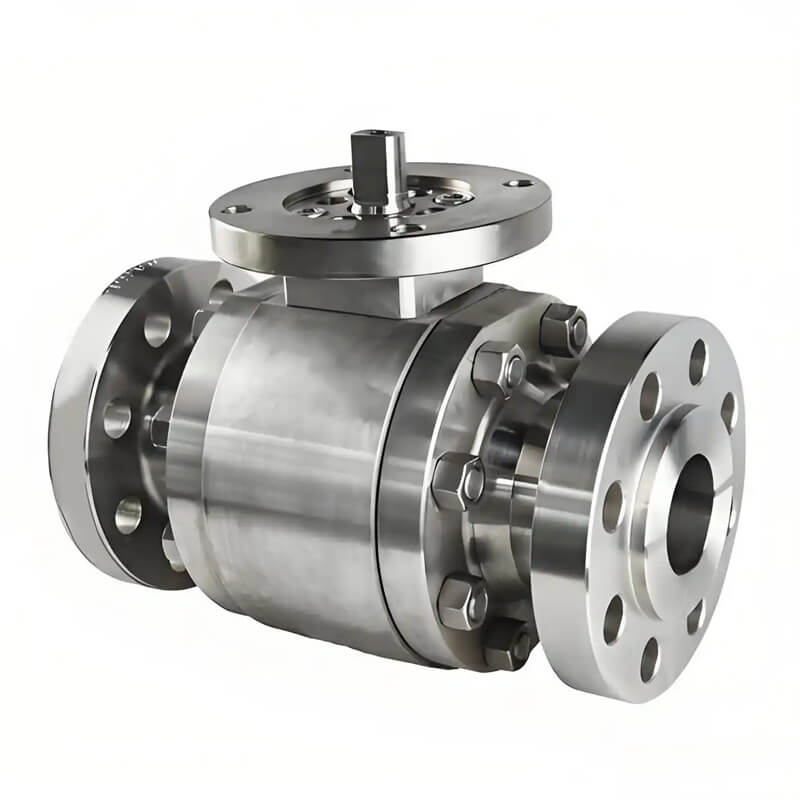
3. Forged Steel Ball Valves: Quarter-Turn Efficiency and Zero Leakage
A 1-inch ball valve for ESD applications uses a hollow, perforated, and pivoting sphere to control flow through the pipeline. These valves are engineered for rapid actuation and absolute sealing integrity.
Key Characteristics & Advantages
- Rapid Quarter-Turn Operation: A simple 90-degree rotation of the valve stem moves the ball from fully open to fully closed, making it ideal for emergency shutdown (ESD) applications. For 1-inch lines, this operation can be completed in under one second with automated actuators.
- Bubble-Tight Sealing: Available in both floating ball and trunnion-mounted designs with soft (PTFE/PEEK) or metal-to-metal seating (for high-temperature/abrasive media), offering zero-leakage performance.
- Compact Footprint: Forged steel ball valves deliver high pressure ratings in a compact body structure, saving weight and space on offshore platforms and complex manifold skids. The 1-inch floating ball design is particularly space-efficient.
Best Applications
Forged ball valves are the standard choice for high-pressure gas pipelines, upstream oil production, cryogenic transport, and critical isolation units requiring quick actuation. A 1-inch ball valve is often the go-to solution for instrument isolation and chemical feed lines.
Comparison Matrix: Gate vs. Globe vs. Ball Valve (1-Inch Size Focus)
| Feature / Criteria | Forged Gate Valve (1″) | Forged Globe Valve (1″) | Forged Ball Valve (1″) |
|---|---|---|---|
| Primary Function | On/Off Isolation | Flow Throttling / Control | Quick On/Off Isolation |
| Operation | Multi-turn (Slow) | Multi-turn (Moderate) | Quarter-turn (90° Fast) |
| Pressure Drop | Very Low | High | Very Low |
| Flow Direction | Bi-directional | Uni-directional | Bi-directional |
| Throttling Capability | Poor (Not Recommended) | Excellent | Limited (Unless specialized) |
| Design Standards | API 602, ASME B16.34 | API 602, BS 5352 | API 6D, API 608, BS 5351 |
| Typical Class Rating | Class 150–2500 | Class 150–2500 | Class 150–2500 |
Technical Considerations for 1-Inch Forged Steel Valve Selection
When specifying a 1-inch forged steel valve for critical piping networks, engineers must evaluate the following technical parameters:
1. Material Selection
- Carbon Steel (ASTM A105): Standard choice for high-temperature clean oil and water services. A 1-inch A105 gate valve is a common stock item for general industrial use.
- Low-Temperature Carbon Steel (ASTM A350 LF2): Designed for low-temperature and cold-climate operations.
- Alloy Steel (ASTM A182 F11 / F22 / F91): Ideal for high-pressure, high-temperature power plant steam lines. A 1-inch F91 globe valve, for instance, can handle steam temperatures up to 1100°F.
- Stainless Steel (ASTM A182 F316 / F316L / F304): Superior corrosion resistance for aggressive chemical and offshore environments. A 1-inch F316 ball valve is standard for offshore instrument air systems.
For detailed material grade comparisons, refer to the ASME B16.34 standard for pressure-temperature ratings.
2. End Connections
Ensure compatibility with system piping using Threaded (NPT), Socket Weld (SW), Butt Weld (BW), or Flanged (RF/RTJ) connections. For 1-inch valves:
- Threaded (NPT): Most common for general-purpose applications.
- Socket Weld (SW): Preferred for high-pressure systems requiring permanent, leak-free joints.
- Butt Weld (BW): Used in critical high-temperature, high-pressure services.
- Flanged (RF/RTJ): Standard for applications requiring easy removal and maintenance.
3. Bonnet Construction
Choose between:
- Bolted Bonnet (BB): For easy maintenance and inspection.
- Pressure Seal / Welded Bonnet (WB): For ultra-high-pressure applications requiring maximum leak-tight integrity.
For a 1-inch, Class 2500 application, a welded bonnet design is typically mandatory to ensure safety and reliability under extreme pressures.
Quality Assurance and Industry Standards
All forged steel valves manufactured by Newsway Valve undergo rigorous quality control procedures, including:
- Hydrostatic testing per API 598
- Pressure testing per ASME B16.34
- Material traceability per ISO 9001:2015
- Non-destructive examination (NDE) including dye penetrant and magnetic particle inspection
These certifications ensure that every 1-inch forged steel gate valve, globe valve, and ball valve delivered to your project meets the highest industry standards.
Partnering with a Reliable Forged Valve Manufacturer
Selecting high-quality forged steel valves—whether 1-inch or larger—ensures pipeline safety, reduces maintenance downtime, and minimizes operational expenditure over the plant’s lifespan. At Newsway Valve, we engineer and manufacture a full spectrum of forged steel gate, globe, and ball valves adhering to stringent API, ASME, and ISO quality standards.
Whether you require standard API 602 forged valves or custom-engineered alloy solutions for severe service environments, our technical engineering team is ready to assist your procurement needs. Our 1-inch forged valve range is available in multiple pressure classes, end connections, and material grades to meet your specific project requirements.
Contact our engineering team today to request a quotation or download our full product catalog.
Post time: Sep-01-2026