

1. What Is a Ball Valve Symbol?
A ball valve symbol is a standardized graphical representation used in engineering drawings—primarily in Piping and Instrumentation Diagrams (P&IDs), Process Flow Diagrams (PFDs), and other schematic documents—to denote a ball valve. A ball valve is a quarter‑turn rotary valve that uses a hollow, perforated sphere (the ball) to control fluid flow: when the ball’s bore aligns with the pipeline, the valve is open; when rotated 90°, the bore becomes perpendicular to the pipe, closing the valve.
In P&ID practice, the ball valve symbol typically consists of two opposing equilateral triangles with a solid or hollow circle at the centre. The central circle represents the ball, while the triangles indicate the valve body connections to the pipeline. This symbol distinguishes the ball valve from other valve types—for example, gate valves (triangles meeting at a point), globe valves (with a vertical line between triangles), and butterfly valves (with a 45° diagonal line).
Common Variations of the Ball Valve Symbol
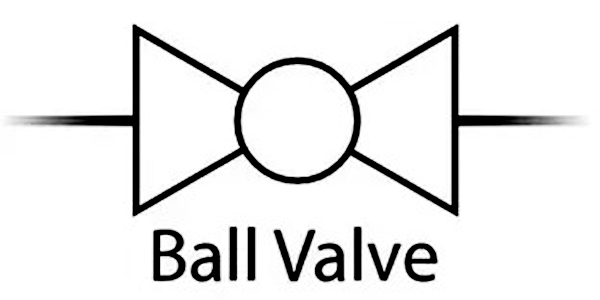
- Two‑way ball valve – the standard two‑triangle‑plus‑circle configuration.
- Three‑way / four‑way ball valves – additional triangles or piping branches are added, and the central circle may contain an “L” or “T” to indicate an L‑port or T‑port flow pattern.
- Actuated ball valves – a vertical stem line extends from the symbol, topped with letters such as E (electric), P (pneumatic), or H (hydraulic) to identify the actuator type.
- Manual operation – indicated by a handwheel or lever handle attached to the stem.
All these symbols conform to internationally recognised standards, including ANSI/ISA‑5.1 and ISO 14617. Most projects also provide a legend sheet that defines every symbol used, ensuring consistency across all documents.
2. Functions of the Ball Valve Symbol in Engineering Drawings
The ball valve symbol is far more than a simple icon—it conveys critical information at a glance:
- Identifies valve type and function – instantly tells the viewer that a ball valve (not a gate, globe, or butterfly valve) is installed at that point, which is essential for system understanding.
- Indicates the actuation method – the attached actuator symbol (pneumatic, electric, hydraulic, or manual) guides selection of control systems, automation strategies, and field operations.
- Defines flow configuration – in multi‑port valves, the “L” or “T” marking inside the ball reveals whether the valve is used for diverting, mixing, or switching flows.
- Shows normal valve position – in some drawing conventions, the solid or hollow fill of the circle, or the orientation of the stem, can indicate fail‑open / fail‑close status or the normal operating position.
- Links to the tagging system – the symbol is always paired with a tag number (e.g., BV‑101 for Ball Valve number 101). This tag connects the drawing to datasheets, purchase orders, and the physical device in the field.
3. Why the Ball Valve Symbol Is Critical in Industrial P&IDs
For engineers, mastering the ball valve symbol is not just about recognising a shape—it is about ensuring accuracy, safety, and efficiency throughout the entire plant lifecycle. Here is why it matters:
3.1. Standardised Communication Across Disciplines
Large‑scale projects involve process engineers, instrument specialists, piping designers, operators, and often international teams. A universally recognised ball valve symbol eliminates language barriers and reduces ambiguity. Consistent symbol usage drastically cuts down engineering changes and rework caused by misinterpretation.
3.2. Essential Tool in the Design Phase
During P&ID development, the ball valve symbol is a design driver—it determines valve selection, actuator choice, and piping topology. By placing and connecting these symbols, engineers translate process requirements, control logic, and mechanical constraints into a coherent, executable design.
3.3. Foundation for Procurement and Construction
The symbol, together with its tag number, becomes the direct reference for purchasing the correct valve and installing it at the right location. Procurement teams use the symbol and tag to retrieve the corresponding technical specification, while construction crews rely on the drawing’s symbol placement for field installation. This ensures seamless alignment between design, purchasing, and construction.
3.4. Key to Operational Safety and Maintenance
During plant operation and maintenance, P&IDs are the go‑to documents for troubleshooting and system modifications. The ball valve symbol helps operators quickly locate the valve, understand its type and actuator, and—in emergency situations—act correctly. Symbols often indicate fail‑safe positions (FC/FO), which are directly linked to safety instrumented functions. A single misinterpreted symbol could lead to an incorrect valve operation, with potentially severe safety consequences.
Real‑world example: On a recent offshore platform project, our team faced a two‑day delay because a junior engineer misread a three‑way ball valve symbol—an L‑port was drawn but the construction crew interpreted it as a T‑port. The wrong piping spool was fabricated, and we had to re‑route several lines. That incident reinforced my own practice: always double‑check the symbol legend and the flow diagram notes before any procurement or fabrication step. Such errors are costly, yet entirely avoidable with proper symbol literacy.
3.5. A Lifelong Information Carrier
The value of the ball valve symbol extends across the entire plant lifecycle—from conceptual design and detailed engineering, through procurement, construction, commissioning, and even later retrofits. The same symbol remains valid and understandable for decades, making it a persistent, reliable link between all phases and all engineering disciplines.
4. Final Thoughts for Engineers
For any engineer working with fluid handling systems, the ball valve symbol is an indispensable part of the visual engineering language. It is not merely a drawing mark but a powerful tool that encapsulates design intent, operational logic, and safety information. Properly using and interpreting this symbol ensures that the entire project team—from designers to operators—works from a single, unambiguous source of truth. That is the essence of professional engineering practice.
5. Frequently Asked Questions (FAQ)
Q1: What is the difference between a ball valve symbol and a plug valve symbol on a P&ID?
A: The ball valve symbol uses two triangles with a central circle; the plug valve symbol typically shows a solid diamond or a circle with a diagonal line inside. Always check your project’s legend for the exact convention.
Q2: How do I show a “fail‑open” or “fail‑close” ball valve on a P&ID?
A: This is usually indicated by adding “FO” or “FC” near the actuator symbol, or by using a specific fill pattern for the ball. Some companies use a small arrow or note beside the symbol. Refer to your company’s standard or ISA‑5.1 for consistent practice.
Q3: Can the same symbol represent both a floating ball valve and a trunnion‑mounted ball valve?
A: Yes—the P&ID symbol does not differentiate between these internal designs. That detail is specified in the valve data sheet, which is linked via the tag number. The symbol only tells you the valve type and basic function.
Q4: Where can I find the official standard for P&ID symbols?
A: The primary standards are ANSI/ISA‑5.1 (available from the International Society of Automation) and ISO 14617. Many engineering firms also develop their own internal legend sheets that supersede the general standards for project‑specific use.
References for further reading:
ANSI/ISA‑5.1‑2022 – Instrumentation Symbols and Identification (see ISA.org)
ISO 14617 – Graphical symbols for diagrams (see ISO.org)
Project‑specific legend sheets (always consult your project’s documentation)
The information above is shared by: NSW VALVE Company Technical Team.
Post time: Jun-25-2026