

A comprehensive engineering guide to Pneumatic Butterfly Valves—covering actuator drive mechanisms, offset designs, torque calculation, ISO 5211 mounting, and API 609 standards for industrial automation.
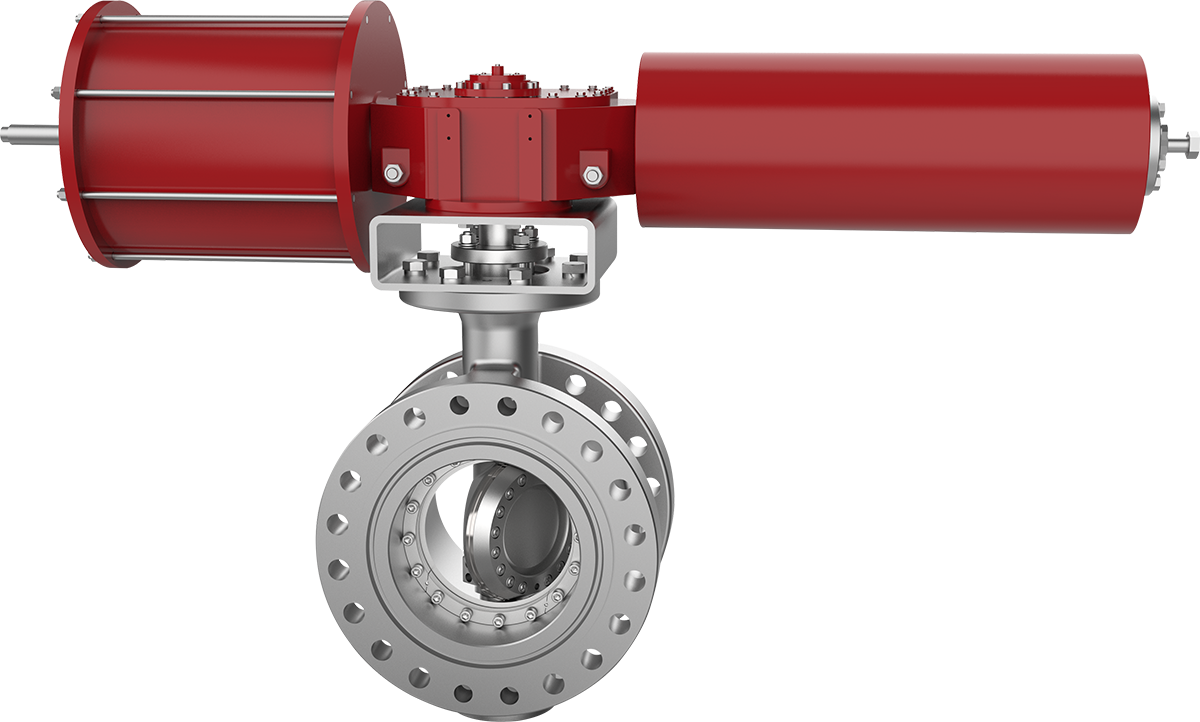
Executive Summary: What Is a Pneumatic Actuated Butterfly Valve?
1. Working Principle & Pneumatic Actuator Mechanics
An automated pneumatic butterfly valve converts pneumatic pressure (typically 4.0–8.0 bar plant air supply) into mechanical shaft rotation. Compressed air acts against internal pistons or diaphragms within the actuator housing, driving a 90° rotary shaft connected to the valve disc via an
ISO 5211 top flange interface.
Types of Butterfly Valve Actuator Drive Systems
Selecting the correct butterfly valve actuator depends on torque output curve, cycle frequency, and valve bore size:
- Rack and Pinion Actuators: Dual pistons with integrated gear racks deliver linear torque across the entire 90° stroke. Compact footprint and rapid cycling make them the industry standard for light-to-medium bore automated valves (DN40 to DN300).
- Scotch Yoke Actuators: A yoke pin-and-block assembly generates a non-linear torque profile with maximum output at stroke ends (breakout and seating). This mechanical advantage makes them ideal for large-diameter, high-performance, or metal-seated triple offset butterfly valves
(DN350 to DN1200+).
Pneumatic Action Modes: Double Acting vs. Spring Return
| Actuator Configuration | Operating Mechanism | Fail-Safe Action Status |
|---|---|---|
| Double Acting (DA) | Requires compressed air on Port A to open and Port B to close. | Fail-in-Place: Holds current position upon loss of supply air. |
| Spring Return (SR / Single Acting) | Air pressure drives one direction while compressing internal springs. Springs drive the opposite stroke. | Mechanical Fail-Safe: Automatically transitions to Fail-Close (FC) or Fail-Open (FO) upon air failure. |
Key Engineering Insight
For safety-critical applications (e.g., emergency shutdown systems), always specify spring return actuators with the appropriate fail-safe position. Double acting actuators are preferred for modulating control where maintaining position during power loss is acceptable.
2. Valve Body Construction & Offset Design Types
The mechanical offset of the disc shaft dictates operating torque, seat friction, and thermal capabilities of an actuator type butterfly valve:
1. Concentric (Resilient Seated) Butterfly Valves
Stem centered in the middle of the disc and seat bore. Utilizes soft elastomeric liners (EPDM, NBR, Viton, or PTFE) to achieve ANSI/FCI 70-2 Class VI zero-leakage shut-off. Best suited for low-pressure water, air, HVAC, and mild chemical services up to 16 bar and 150°C.
2. Double Offset (High-Performance) Butterfly Valves
Shaft offset from both the seat center and pipe bore center. This dual eccentricity causes the disc to “lift” off the seat during rotation, reducing friction, lowering seating torque, and extending seat service life. Available with PTFE/RPTFE soft seats or flexible metal seal rings for medium-pressure
steam and process lines.
3. Triple Offset (TOBV) Metal-Seated Butterfly Valves
Features a third offset angle integrated into the seat cone geometry. This non-rubbing, cam-action design achieves friction-free rotation and tight metal-to-metal seating (Stellite / Laminated Stainless Steel). Engineered for severe service, high temperatures up to 550°C+, cryogenic fluids, and fire-safe operations.
End Connection Options
- Wafer Type: Compact body held between pipe flanges by through-bolts. Lowest weight and footprint.
- Lug Type: Threaded lugs on the body matching flange bolt patterns. Allows dead-end service and downstream line maintenance.
- Double Flanged Type: Integrated flanges on both ends; mandatory for large diameters (DN300+) and buried or heavy pipeline stress installations.
3. Automated Control Loop Accessories
To convert a standard pneumatic butterfly valve into an intelligent final control element, a combination of pneumatic accessories is direct-mounted via NAMUR and ISO 5211 interfaces:
Standard Automation Accessories Package
- Electro-Pneumatic Valve Positioners (4–20mA / HART / Fieldbus): Regulate air pressure based on control signal input for precise modulating flow control.
- Solenoid Valves (3/2-Way or 5/2-Way NAMUR Mount): Control air supply direction for on-off isolation duty. SIL 3 options available for safety shutdown lines.
- Limit Switch Boxes (Ex d Explosion-Proof / IP67): Provide local visual indication and transmit electrical open/close position feedback to PLC or DCS.
- Air Filter Regulators (AFR): Filter particulate matter down to 5 microns and maintain stable supply air pressure to protect internal actuator seals.
- Manual Declutchable Overrides: Handwheel gearboxes mounted between valve and actuator that allow manual operation during total compressed air or electrical failure.
For more detailed information on accessory selection, visit our Valve Automation Accessories Guide.
4. Engineering Actuator Sizing & Design Standards
Accurate actuator sizing is critical to prevent valve chatter, stem deformation, or actuator stall during unseating under maximum differential pressure.
Actuator Sizing Calculation Formula
Engineering Tip: Always apply safety factor multipliers based on media type:
- 1.25 — Clean lubricating liquids
- 1.30 to 1.40 — Dry gas and compressed air
- 1.50+ — Slurries, viscous liquids, or high-temperature steam
Key Manufacturing & Quality Specifications
- Design & Manufacture: API 609, ASME B16.34, ISO 10631, EN 593
- Testing & Inspection: API 598, ISO 5208, EN 12266
- Actuator & Accessory Interface: ISO 5211 (Top Flange), VDI/VDE 3845 (NAMUR)
- Fire-Safe Certification: API 607, ISO 10497 (Triple Offset Types)
- Fugitive Emissions Certification: API 641, ISO 15848-1
5. Frequently Asked Questions (Engineering FAQ)
Q1: Can a pneumatic actuator butterfly valve be used for precise modulating flow control?
Yes. By equipping a double offset or concentric butterfly valve with a digital electro-pneumatic positioner (4–20mA signal), the assembly acts as an effective modulating control valve for high-flow, low-pressure drop pipelines.
Q2: What is the main advantage of an actuator type butterfly valve over a ball valve?
Pneumatic butterfly valves are significantly lighter, more compact in face-to-face dimensions, and considerably more cost-effective in large line sizes (DN200 / 8-inch and above) compared to equivalent-size ball valves.
Q3: Why is ISO 5211 mounting standard important for a butterfly valve actuator?
ISO 5211 defines uniform bolt patterns, drive shaft dimensions, and flange dimensions. This ensures standardized interchangeability, allowing pneumatic actuators from various manufacturers to direct-mount onto valve stems without custom brackets.
Q4: What is the difference between soft-seated and metal-seated butterfly valves?
Soft-seated valves use elastomeric or PTFE seats to achieve zero-leakage shut-off at lower temperatures (typically ≤150°C). Metal-seated valves (triple offset) use metal-to-metal sealing and can withstand temperatures up to 550°C+, making them suitable for steam, thermal oil, and cryogenic services.
Have more questions? Browse our Complete Valve FAQ or contact our engineering team directly.
Need Help Selecting the Right Pneumatic Actuator?
Our valve engineering team can help you size, specify, and source the optimal pneumatic actuator butterfly valve for your application—complete with torque calculations, accessory packages, and compliance documentation.
Post time: Sep-06-2026