

Pneumatic Actuated Ball Valves are critical components in industrial automation for flow control and emergency isolation.
This engineering guide provides a systematic approach to pneumatic ball valve selection—covering
rack & pinion vs. scotch yoke actuator comparisons, double-acting vs. spring-return fail-safe logic,
ESDV (Emergency Shutdown Valve) integration, API 6D design standards,
torque sizing calculations, and material selection for severe service conditions.
Whether you are a process engineer, project procurement specialist, or maintenance technician, this reference is designed for daily use.
1. Working Principle & Actuator Drive Mechanisms
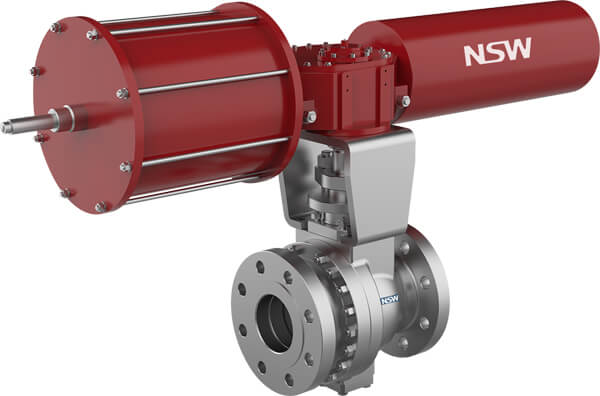
A pneumatic actuated ball valve consists of a quarter-turn ball valve body
mated to a pneumatic actuator. The actuator converts compressed plant air (typically
4.0–8.0 bar / 60–115 PSI) into mechanical torque, driving the valve stem and ball through a 90° rotation
to rapidly open or close the flow path.
1.1 Pneumatic Actuator Types
- Rack & Pinion Actuators: Feature dual opposed pistons with gear racks engaging a central pinion.
Benefits include compact footprint, linear torque output, high mechanical efficiency, and fast response.
Ideally suited for small-to-medium bore valves (½” to 12″). - Scotch Yoke Actuators: Utilize a yoke mechanism that produces a non-linear torque curve—
delivering maximum torque at both the break-open and seat-sealing positions.
This makes them the optimal choice for large-bore trunnion-mounted ball valves
(DN150 to DN600+ / Class 150 to Class 2500).
1.2 Double-Acting vs. Spring-Return (Single-Acting)
Selecting the correct actuator action mode directly impacts process safety during air supply failure:
| Actuator Action | Air Supply Operation | Fail-Safe Status (Loss of Air) |
|---|---|---|
| Double-Acting (DA) | Air to Port A opens; air to Port B closes | Fail-in-Place: Valve holds last position |
| Spring-Return (SR) | Air pressure compresses springs for one stroke; spring energy drives return | Mechanical Fail-Safe: Automatic Fail-Close (FC) or Fail-Open (FO) |
spring-return actuators are mandatory to ensure automatic valve positioning to a safe state upon loss of instrument air or plant power.
2. Valve Body Construction & High-Performance Seating
Long-term reliability of a pneumatic ball valve depends not only on the actuator but also on
the valve body design and seating material selection. Consider operating temperature, pressure,
corrosiveness, and particulate content when selecting materials.
2.1 Valve Body Configurations
- Floating Ball Design: Suitable for DN15–DN100, Class 150–300 applications.
Upstream pressure forces the ball against the downstream seat for sealing. Simple and cost-effective. - Trunnion-Mounted Ball Design: Required for DN50–DN600, Class 150–2500 high-pressure/large-bore services.
The ball is anchored by an upper stem and lower trunnion bearing, reducing operating torque by up to 50%
and protecting sealing surfaces—ideal for frequent automated cycling. - Live-Loaded Packing: Belleville spring-energized flexible graphite packing maintains
consistent radial load, compensating for thermal cycling and meeting API 641 and
ISO 15848-1 fugitive emissions standards.
2.2 Seating Material Comparison
| Seat Type | Typical Materials | Temperature Range & Characteristics |
|---|---|---|
| Soft-Seated | PTFE / RPTFE / PEEK / PPL | −29°C to 260°C (PEEK up to 300°C) ANSI/FCI 70-2 Class VI bubble-tight shut-off |
| Metal-Seated (HVOF Coated) | Tungsten Carbide / Chrome Carbide (HRC 68–72) | −196°C to 650°C High-temperature steam, slurries, catalyst particles, abrasive media |
For severe service conditions involving high temperatures, high differential pressure, or solids-laden media,
metal-seated trunnion ball valves with HVOF thermal spray coatings are strongly recommended.
3. ESDV Emergency Shutdown & Control System Accessories
In petrochemical, gas transmission, and power generation industries, pneumatic ball valves are frequently
specified as ESDV (Emergency Shutdown Valves) or EIV (Emergency Isolation Valves).
These are final control elements within Safety Instrumented Systems (SIS), where
response speed and reliability directly impact plant safety.
Typical ESDV Accessory Package for Pneumatic Ball Valves
- Solenoid Valves: NAMUR interface, 3/2 or 5/2 way, SIL 2/3 certified for electrical-pneumatic interlocking.
- Smart Valve Positioners: 4–20mA + HART / Profibus PA, enabling modulating control and online diagnostics.
- Limit Switch Boxes: IP67 / Ex d explosion-proof, providing open/closed position feedback to DCS/PLC.
- Air Filter Regulators (AFR): 5μm filtration, stabilizing supply pressure and extending actuator seal life.
- Partial Stroke Testing (PST) Devices: Online testing of 10–15% valve stroke to verify ESDV availability without process interruption—reducing SIL verification risk.
For high-speed ESDV applications requiring full-stroke closure in 0.5–1.0 seconds,
additional components such as quick-exhaust valves and high-flow pilot valves
should be specified to minimize actuator exhaust time.
4. Actuator Sizing Torque Calculation & Design Standards
The most critical step in pneumatic actuator selection is torque matching.
Under-sizing causes valve stalling or incomplete closure; over-sizing increases cost, footprint,
and may impose excessive stress on the valve body.
4.1 Actuator Sizing Formula
Select the highest value among these three torque components as your baseline:
- Breakout Torque: Maximum torque required to initiate rotation from static position.
- Running Torque: Torque required to maintain rotation through the stroke.
- Seating Torque: Torque required to seal the ball against the seat at the closed position.
· Dry gas service: Torque × 1.3
· Slurry / high-viscosity service: Torque × 1.5
· High-temperature (>400°C): Consult manufacturer for thermal expansion effects on torque.
4.2 Key Design & Testing Standards
Pressure & Leakage Testing: API 598, ISO 5208, ANSI/FCI 70-2
Fire-Safe Certification: API 607, ISO 10497
Fugitive Emissions: API 641, ISO 15848-1
Actuator Mounting: ISO 5211 / NAMUR
Functional Safety: IEC 61508 SIL 2 / SIL 3 Capable
5. Frequently Asked Questions (FAQ)
6. Conclusion & Selection Checklist
Selecting the right pneumatic actuated ball valve requires a systematic evaluation of
process parameters, safety requirements, and lifecycle cost considerations. Use the following checklist
to guide your specification:
- Define process conditions: Pressure, temperature, media type, flow rate, and particulate content.
- Select valve architecture: Floating ball (small bore) or trunnion-mounted (large bore / high pressure).
- Choose seating material: Soft-seated (Class VI shut-off) or metal-seated (severe service / high temp).
- Select actuator type: Rack & pinion (compact, linear torque) or scot yoke (high breakout torque).
- Determine action mode: Double-acting (fail-in-place) or spring-return (fail-safe FC/FO).
- Calculate sizing torque: Breakout × safety factor (1.30–1.50) with media multipliers.
- Specify accessories: Solenoid valves, positioners, limit switches, AFR, and PST if required.
- Verify compliance: API 6D, API 607, API 641, ISO 15848, and SIL ratings as applicable.
with partial stroke testing (PST) capability to maintain Safety Integrity Level (SIL) compliance
and ensure valve availability during emergency conditions.
Need Expert Assistance with Your Pneumatic Ball Valve Selection?
Our engineering team specializes in API 6D pneumatic valve solutions for ESDV, on-off, and control applications.
Get sizing support, material recommendations, and certified product documentation.
Post time: Aug-27-2026